UK CEDAW ~ Non-State Torture first mentioned in WRC CEDAW Report 2013
In February 2011, I attended a Women’s Resource Centre Shadow Report Day in Newcastle UK. I spoke out about the reality of non-State torture including ritual abuse-torture, that women and girls/children suffer in the home and/or other places by family and other private individuals and groups within the UK.
Torture suffered in the domestic realm as a girl or woman, is a genderised form of violence against women and girls. Women and girls in the UK can suffer torture violence harms in the home, in other private spaces both by family and other private persons, through being trafficked, through domestic violence, and though prostitution.
There are few if any statistics on numbers of women or girls who have suffered torture by non-State actors in the UK.
Non-State torture is commonly misnamed abuse or aggravated assault.
In the UK human rights specific socio/legal recognition, understanding, support and care for women and girls who have suffered non-State torture is missing.
UK Committee on the Elimination of All Forms of Discrimination Against Women (CEDAW) 2013
The UK Government was examined on 17 July 2013 at the 55th Session of the Committee on the Elimination of All Forms of Discrimination Against Women (CEDAW) at the United Nations (UN) in Geneva on its women’s rights record and the problems impacting on women’s equality in the UK.
CEDAW is a unique opportunity for women to raise issues they are facing in the UK with the UN CEDAW Committee, who can ask questions of the UK Government directly as the UK is bound by the CEDAW to uphold women’s human rights as a signatory of UN CEDAW Convention.
The Women’s Resource Centre (WRC), in 2013, together with a working group and women from over 42 UK NGO’s had produced an extremely comprehensive report which brought together issues and realities impacting on women and girls in the UK.
It was the first time non-State torture (NST) was named as a form of men’s violence against women and girls in the 2013 WRC UK Shadow Report.
Human rights defenders and grass-root supporters Jeanne Sarson and Linda MacDonald of Persons Against Non-State Torture in Nova Scotia, Canada have been advocating for non-State torture to be included in the Canada’s criminal code for the last twenty-five years.
After the meeting in Newcastle in 2013, I asked Jeanne and Linda if they would write a report about Non-State Torture for the WRC shadow report. Their report was included under General Recommendation Article 19 – Violence Against Women and Girls pages 193 -194 19.86 and in Appendix 34 to the Women’s Resource Centre’s UK CEDAW Shadow Report 2013 below with a recommendation:
Women’s Equality In The UK – A Health Check Shadow Report from the UK CEDAW Working Group – assessing the United Kingdom Government’s progress in implementing the United Nations Convention on the Elimination of All Forms of Discrimination Against Women (CEDAW) April 2013
Appendix 34 in Women’s Equality In The UK – A Health Check Shadow Report from the UK CEDAW Working Group on non-State torture refers to the CEDAW 1992 General Recommendation 19, violence against women, paragraph 7(b) which says…”the right not to be subjected to torture..”
Recommendation
“Torture inflicted against women and girls by non-State actors in the domestic/private sphere be specifically named and criminalised. In the light of the evidence in recent years of very serious cases of failure to protect women and girls experiencing violence from very serious harm and cruelty and, in some cases, torture, further action must be taken to ensure that statutory services, including the police, social services and NHS, understand their duty to protect women and girls they know to be at risk, and to prevent abuse and torture.”
UK CEDAW Examination UN Geneva ~ July 2013
I attended the UK CEDAW examination at the UN in Geneva in July 2013 supported by the National Alliance of Women’s Organisations (NAWO), with the UK delegation of women’s human rights activists from UK NGO’s. NAWO published my 2013 Journal Report.
Our UK delegation had a lunch time meeting with the CEDAW committee members. I put my NST poster on the wall of the meeting room with other women’s posters.


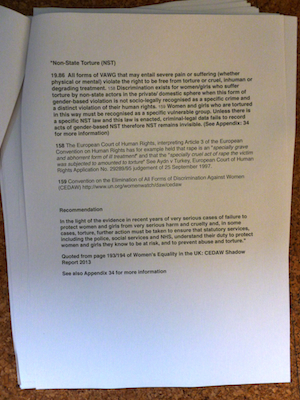
I also printed information sheets on NST drawn from the WRC Shadow Report with the Recommendation underneath to add to the visibility of the information on NST on the table with everyone else’s information for the CEDAW committee members to see.
At a meeting our UK delegation had on the stairs I asked our Rapporteur Dr Ruth Halperin Kaddari:


“I would like to know…that as some violence against women and girls in the domestic realm is torture, could the [UK] Government be questioned on whether it has looked at and responded to this specific violation of non-State torture… [as it is in Appendix 34 in the Shadow Report?]”
This question had been previously drafted by Jeanne and Linda that the CEDAW expert asked the Canadian Government in their CEDAW examination at the UN in Geneva on 23 October 2009.
After the UK CEDAW examination in Geneva in July 2013, the CEDAW Working Group provided: “Recommendations for concluding observations from the UK CEDAW Working Group – focus on England and Wales” for the CEDAW Committee’s Concluding Observations. The Recommendations included under General Recommendation 19 – Violence Against Women and Girls: “Use the UN CEDAW definition of VAWG and include non-State torture in this definition.”
This recommendation was not included in the CEDAW Committee’s Concluding Observations.
Further Notes on Non-State Torture and CEDAW
Quoted from an email from Jeanne Sarson and Linda MacDonald – 2018
“Naming Non-State Torture (NST) as a violation of the human rights of women and girls. All forms of violence against women and girls that may entail severe pain or suffering (whether physical or mental) violate the right to be free from torture or cruel, inhuman or degrading treatment.
Discrimination exists for women/girls who suffer torture by non-state actors in the private/domestic sphere when this form of gender-based violation is not socio-legally recognised as a specific crime and a distinct violation of their human rights.
Women and girls who are tortured in this way must be recognised as a specific vulnerable group. Unless there is a specific NST law and this law is enacted, criminal-legal data fails to record acts of gender-based NST therefore NST remains invisible.
The European Court of Human Rights, interpreting Article 3 of the European Convention on Human Rights has for example held that rape is an “specially grave and abhorrent form of ill-treatment” and that the “specially cruel act of rape the victim was subjected to amounted to torture”. See, Aydin v. Turkey, European Court of Human Rights, Application No.29289/95, judgment of 25 September 1997
Convention on the Elimination of All Forms of Discrimination Against Women (CEDAW) http://www.un.org/womenwatch/daw/cedaw/text/econvention.htm#article1
LINKS TO EVIDENCE:
1. CEDAW General Recommendation 19, 7(b) that says no one shall be subjected to torture;
2. CEDAW General Recommendation 35 which states it is a woman’s right to a life with “freedom from torture” (para. 15). Furthermore paragraph 16 specifically identifies that “gender-based violence against women, may amount to torture when perpetrated within the domestic sphere by non-State actors, therefore non-State torture (NST) needs to be addressed in a gender-sensitive manner“ (para. 17). And “under the obligation of due diligence, States parties . . . . are required to have laws, institutions and a system in place to address such violence” (para. 24 (b).
3. The Geneva NGO Forum on Beijing+20 UN ECE Regional Review – Final Report that says: “All State parties must ensure national laws criminalise non-State torture perpetrated by non-State actors and that laws prohibit and hold perpetrators accountable for gender-based non-State torture crimes” (p. 19, 94). Further saying, “ Identify and recognise non-state torture by non-state actors e.g. spouses, parents and human traffickers, [and] protect the victims of this type of torture (p. 113). . . . . [including] of older women (134, 136).”
 artprintspace.net
You must be logged in to post a comment.