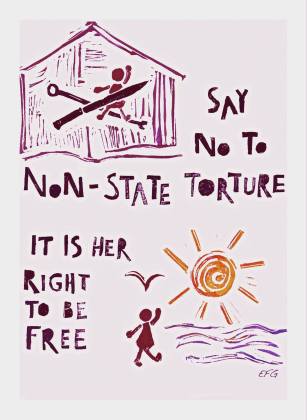
“Say No To Non-State Torture. It Is Her Right To Be Free” Purple print 2015


The Art Exhibition at Feminism in London in 2015, with Jeanne Sarson and Linda MacDonald’s leaflets on non-State torture.
Non-State torture is torture perpetrated in the home and other private places. See the website of Jeanne Sarson and Linda MacDonald at www.nonstatetorture.org
Originally, I created this poster for a UN European poster competition in 2011 to raise awareness that non-State torture is a specific form of violence against women and girls.
Original poster created in May 2011 with logo added for a UN poster competition
“Thank you Elizabeth for such a beautiful visual statement of liberation. Non-state torture, particularly pedophilic torture, can start when women are infants. To have your poster making such a liberation statement is certainly expressing hope and “her right to be free”!” Jeanne Sarson, Canada ~ May 2011
“Non-state torture (NST) is a very invisible crime and human rights violation against women. Thank-you Elizabeth for making non-state torture visible in your powerful poster.” ~Linda MacDonald~ www.nonstatetorture.org ~ May 2011


My inspiration came from the woodcut prints by Brazilian artist Otavio Roth who then created linocut prints of the 30 articles of the Universal Declaration of Human Rights that are now displayed along a wall inside the UN in Geneva and New York.
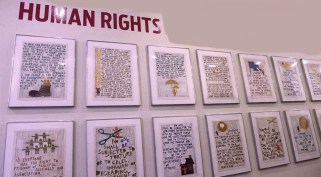
Haldane Society of Socialist Lawyers Journal published the NST Poster in edition 73, June 2016
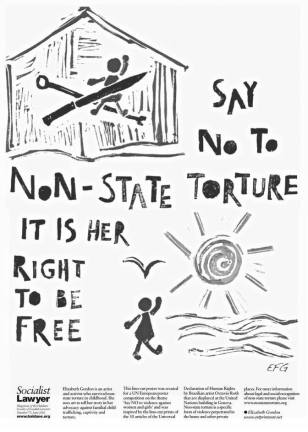
Black and white version of the NST poster created for the Magazine of the Haldane Society of Socialist Lawyers Number 73 Journal Publication June 2016
The Universal Declaration of Human Rights and Otavio Roth
The Universal Declaration of Human Rights was adopted by the UN General Assembly on 10 December 1948. It declares that all human beings “are born free and equal in dignity and rights” and goes on to specify in its 30 articles specific areas of freedom. In December 1989, the Assembly went on to adopt a 54-article Convention on the Rights of the Child.
Otavio Roth worked to help spread the message of the Declaration around the world and he was first inspired to work on the document when he was an art student in London in 1977. It took him two years to complete a set of 60 x 80 centimetre prints, derived from woodcuts which he carved in reverse images on wooden blocks.
The linocut prints of these works were embossed on handmade paper. They were purchased by the United Nations and exhibited in the UN Headquarters lobby in New York from December 1982. Two more sets were acquired for both the UN Centre in Vienna and Geneva Headquarters.
Shortly after the first UN exhibition Octavio considered the possibility of adapting his illustrations in the form of a children’s book.
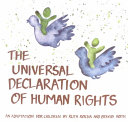
Together with Ruth Rocha, a Brazilian writer of children’s books they created the children’s book version of the Universal Declaration of Human Rights.
 artprintspace.net
You must be logged in to post a comment.